
Thursday, February 27, 2014

A chip off the old bulb.

Seven months after the announcement, it still seems like the largest municipal bankruptcy filing (at least up to this point) is the stuff of legend—the culminating event, after successive blunders.  The apex.  Or the nadir.  No doubt those of us living here are guilty of a degree of chauvinism as we experience how it plays out firsthand, but it’s easy for anyone with even moderate media curiosity to see how much the city has hogged the headlines.  It may be for all the wrong reasons, but Detroit is prominent once again.


Yet it was only weeks—if not days—after the declaration made international news that, in order to convey to the world the magnitude of the city’s financial woes, journalists honed in on more mundane failures—failures that, by virtue of their banality, were all the more shocking.  Locals have known about them for ages.  A portfolio of abandoned public school real estate larger than many cities’ functional school systems.  An absence of snowplows, even after heavy storms.  A stonewall of silenced civil servants, hogtied from effectively carrying out duties by daily uncertainty about the security of those same jobs.  The virtual absence of any emergency response, resulting in two-hour waits for an ambulance or a police call.


But the one that crowds out the rest, no doubt at least partially due to its ubiquity and ordinariness, is the persistent non-functionality of those streetlights.  One of the editorialists for the Free Press has branded it “the city’s deepest embarrassment”.  By most estimates, up to 40% are out on any given night.  Anyone passing through can tell when crossing into the city limits for this exact reason: even huge stretches of the interstates are black, although they’re state or federal highways.  It’s hard to determine if these shadowy streets originate from a cash-strapped DPW’s inability to replace the bulbs—which obviously require periodic maintenance—or an oversight that far precedes the checkered Kilpatrick administration, when the city’s fiscal woes first garnered national attention.  All it takes is a trip down Mack Avenue on the city’s east side to postulate that the problem is a half-century in the making.



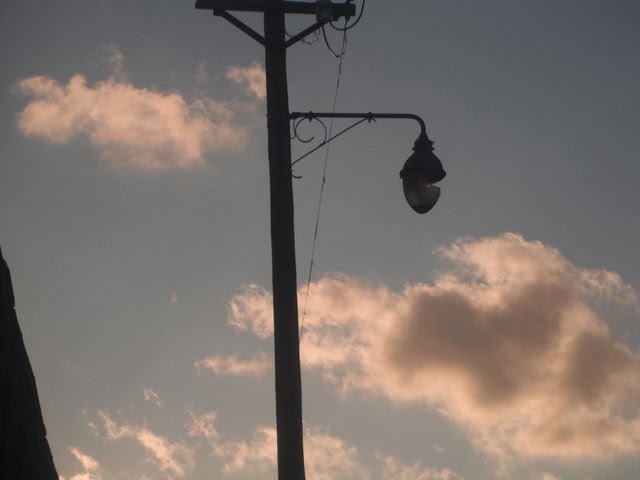
Silhouettes of streetlights punctuate the dusky penumbra, but even at a distance, the shape of these lights seems odd.  Antiquated?  Probably.  And a closer view confirms it.


To be frank, I can’t recall seeing lights like this before anywhere else in the country, and I’m well-traveled across some of the more economically deprived pockets.  From the baroque iron filigree work of the stanchion to the acorn shape of the light itself, my guess is this streetlight comes from an inventory that most cities had fully retired over three decades ago.  And there’s probably good reason for that: this one is broken.


And so is another one half a block away.

About half of the lights along this stretch of Mack use this design, and most are cracked.  A big distended bulb offers more surface area encased in glass—more space for something to wrong.  Whether hit by flying debris hit or (my suspicion) deliberately smashed by a passer-by, this streetlight is almost definitely non-operational.  And the visible hardware is only half the problem: inside that quaint, clunky bulb (your grandmother’s streetlight) is—or was—a mercury vapor lamp. Detroit is one of the few cities that still depends heavily on this less efficient, increasingly obsolete method of illumination; most other large cities have replaced their inventory with superior metal halide lamps.   USA Today also noted that Detroit and Milwaukee share the dubious distinction of being the only large cities that still deploy series circuits for much of the streetlight network, meaning that if one transformer box breaks down, the whole strip of lights goes dark, like an old string of Christmas tree lights.  While the Mack Avenue streetlight featured above remains attached to a wood, other lights in the city append to metal poles, presumably the same age as the lights themselves, characterized by rust, peeling paint, and sometimes even open cavities at the base.  The whole contraption has seen better days.


But viewing these cracked eggs through a cultural lens can help temper some of the scorn.  They might not work well as modern lamps and they’re much easier to vandalize, but they’re relics—they’re curiosity items.  And they’re particularly eye-catching along Mack Avenue because there are so many of them, yet they’re still interspersed with more contemporary designs.  This cool pic doesn’t win awards for clarity, but it still shows the juxtaposition of old and new streetlights, through their silhouettes.


Or on opposite sides of the street.


And on a depopulated residential street not so far from Mack, a different kind of lighting style emerges—perhaps not as old-fashioned but still an oddity.


Perhaps a style and technology that never caught on?


The irony of the 1950s-era (or maybe even 1940s) lighting that lingers on in Detroit is that, in a broader spatial context, it exemplifies technological advancements playfully defying shifts in taste culture for a particular design.  On Mack Avenue, ancient streetlights bespeak a broke, ineffective government.  And yet, elsewhere in the metro, they convey something else.


Forgiving the quality of the photo, it’s still easy to see a similar style of lighting to the ones on Mack Avenue, but this time they’re impeccable.


But this is the comfy suburb of Livonia, presumably part of a streetscape improvement along a thoroughly auto-oriented corridor of strip malls and big boxes.  And they no doubt were a deliberate choice from the Public Works Department because they look good—providing a vintage, old-timey feel.  Apparently they don’t worry in Livonia about ne’er-do-well pedestrians throwing rocks at these distended bulbs.  Maybe it’s because Livonia has few ne’er-do-wells….and even fewer pedestrians.  But even some of the economically healthier neighborhoods within Detroit have caught the bug, replacing older streetlights with a newly vintage design, like these twin lamps in Midtown, near Woodward Avenue:


This inversion of taste cultures pervades streetscapes across the country, where everything old is new again, in order to exploit nostalgia among a generation that never really experienced a normative walkable environment—a landscape that was still the standard during the era when city crew first installed those acorn mercury vapor lamps.  We’re seduced by nostalgia and novelty; a hybrid of the two is doubly sweet.  Just go to the French Quarter in New Orleans, where a city equally negligent in modernizing its utilities now capitalizes on this same inertia—the flickery gas lanterns that once were a backwater embarrassment are now ambiance.  Detroit isn’t yet so lucky to take similar advantage of its obsolete lighting (and the fact that most streets like Mack are a hodgepodge of styles doesn’t help), but that doesn’t mean that an emergent cultural voice won’t someday call those lights “genuine retro”, and the preached-upon choir will be listening.


The periodic “freshening” of basic urban infrastructure is only partly due to necessity, as it may very well be in Detroit.  But a great deal simply has to do with keeping up with the joneses, resulting in often needlessly costly capital investments.  For example, the standard for pedestrian signals at intersections now typically involves a “countdown” timer, telling pedestrians exactly how many seconds they have left to cross.  While useful, are these timer boxes essential?  Regardless, public works departments are rapidly phasing out the single-box approach for these new timer-boxes, with little evidence of public advocacy one way or another (despite the fact that the public inevitably is paying for most of these replacement costs).  From decorative viaducts to Day-Glo yellow road caution signs, jurisdictions hell-bent on an infrastructural one-upmanship should look to Detroit as an inverse exemplar—what might happen when profligacy goes perpetually unchecked.  Unless, of course, these granny-and-gramps streetlights become hip and cool again, in which case the Motor City might have the last laugh.


Wednesday, February 19, 2014

Plowing the factories to plant a field.

-->
Cities large and small have borne the brunt of criticism from economic development experts for investing heavily in sports venues, in an effort to bring people back—and thus to help revitalize—their old downtowns.  I’ll admit it: I’ve been one of these critics in the past as well, heaping three successive blog articles of scorn to the City of Evansville in its decision to tear down a block of century-old commercial buildings in order to build a new arena.  To be honest, I directed my “scorn”—a pretty overblown word—mostly toward the decision to demolish old commercial buildings, rather than act of relocating an arena downtown in general.  Regardless, I’ve continued to receive comments from naysayers who think that the site of the Evansville arena was perfect, and that my criticism was unfounded.  Maybe I will eat crow someday, but I hold my ground that an indoor arena is hardly a panacea for an ailing downtown, especially when it replaces a structure that is superior from an urban design standpoint.


The City of Toledo offers another target for those venom-tipped arrows—a baseball diamond that precedes its basketball counterpart in Evansville by a good decade.  Though a larger metro than Evansville (at 650,000 to Evansville’s 350,000), Toledo still has a long way to go before it could become an alpha/first-tier city, either in the Midwest or even in Ohio.  And, based on the current trajectory, its not a likely aspiration: in recent decades, Toledo’s population has plunged 25%, while even the suburbs—most of which are comfortably middle class—have remained flat.  But in 2002, the MiLB’s Toledo Mud Hens christened the brand-new Fifth Third Field, a significant relocation from its predecessor, the Ned Skeldon Stadium in the suburb of Maumee.


According to a Toledo Blade article from 2002, quite a few civic leaders perceived Ned Skeldon Stadium as less than ideal, just years after Lucas County Commissioner Skeldon brought the Mud Hens back to Toledo in 1965 after a ten-year absence.  Teaming with a local banker, Skeldon had converted a county racetrack at the fairgrounds to this Lucas County Stadium.  Despite an abundance of parking, an on-site restaurant, several suites, and the MiLB standard provision of at least 10,000 seats, this suburban stadium never drew great crowds.  A Ballpark Digest article recognizes that the stadium suffered from uncomfortable bleachers, numerous seats behind support poles, and the complete incapacity to expand the luxury boxes critical to generating good revenue through corporate rentals.   In 1988, shortly before Skeldon’s death, the City renamed the facility after him in his honor.  And just weeks after filling the dirt over his casket, officials announced their interest in building a new stadium downtown.  Over the next decade, as more of the pieces fell into place, successful ballparks opened in Louisville and Indianapolis, further galvanizing enthusiasm for an equivalent edifice in Toledo.


Fifth Third Field Toledo (not to be confused with the identically named ballpark in Dayton, Ohio) sits snugly within the downtown warehouse district, tucked among sturdy brick midrises from the late 19th century.  Try as I might to probe the history of the site, I can find no evidence of any controversy to the location that Mayor Carty Finkbeiner and other officials ultimately decided upon for the ballpark.  The only conclusion I can draw is that, like the Evansville Arena, the City eliminated a block of public right-of-way in order to procure the needed contiguous space to build such a large facility.  The Google Map below shows the obvious gap where Superior Street used to continue uninterrupted.


Did the choice to locate in the heart of downtown ruffle any feathers? Did any prominent or historic buildings have to come down?  Or was the surrounding neighborhood so blighted and bereft of investment that few people questioned this decision?


The April 2002 Blade article announcing the Field’s opening only manages to expound upon the mild question of whether the City needed a new structure badly enough to justify over $30 million in expenditures, especially in the face of considerable demand for a new juvenile justice center and Sixth District Court of Appeals.  No hand-wringing over what got demolished to make room for the new venue.  But a partnership between the City and local businesses—coupled with lucrative advance sales of the luxury suites—helped to finance construction.  The result stands as a proud and lively achievement in harnessing energy back to the historic city center, manifested on a sunny Sunday summer afternoon.


While this The Atlantic Cities article speculates that city officials were originally chary to build a stadium without any explicitly dedicated parking, it might have been prudent in the long run.  Visitors to downtown Toledo must either seek garages a few blocks away or on-street parking in the surrounding neighborhood.  Which, apparently, is exactly what they do.


This same article also observes (again, quite speculatively) that the opening of Fifth Third Field represented the first time many Toledans had paid for a parking spot downtown, walking by buildings and storefronts that were slowly enjoying a mild rebirth, as investment began to recentralize through the installation of this new activity hub.  Many of the blocks immediately surrounding the ballpark now offer bars and restaurants.


Fifth Third Field undoubtedly helped breathe life into a downtown that ostensibly had tumbleweeds blowing across main street on weekends in the 1990s.  Nonetheless, few visitors would ever label today’s downtown Toledo “flourishing”.  While a few of the blocks in the immediate vicinity of the stadium are quite lively, any perspective of downtown more than two blocks further portrays an entirely different scenario.


To be fair, I could have framed my pictures so that they deliberately lack people, using that mise en sceneto demonstrate dishonestly that much of downtown Toledo isn’t vibrant.  And, of course, Sunday afternoon is never a fair assessment, because even America’s liveliest cities can appear sleepy on this day of rest.  But notice that most of the buildings in the above photos lack any discernible tenant.  Nothing is animating the structures from the inside, let alone the outside.  The energy simply remains so concentrated in an isolated portion that the resulting impression is that downtown Toledo has a lively little restaurant row right around its baseball field—not that the downtown is lively in itself.


In defense of Mayor Finkbeiner and the ballpark boosters, Fifth Ford Field really did arrive on the downtown Toledo scene with the best of intentions.  If the City had decided to finance a parking garage, not only would the end product cost much more, but it would have further steered motorists into a dedicated space immediately next to the stadium, unnecessarily concentrating human movement to a single facility.  By forcing suburbanites to find their own parking, they have no choice but to toddle around the adjacent streets.  Also, several of the stadium’s walls are completely permeable, meaning that the architects avoided turning the stadium into a fortress.  Notice, for example, this Google Streetview from St. Clair Street.  Passers-by can look right in, giving sensory appeal from the streetscape.


On two of the four corners, the designers maintained corner buildings with retail frontage, or else they decided to add some of their own, manifested by this photo:

Unfortunately, the portion of the stadium fronting Huron Street achieves an effect that is antithetical to good urbanism, as evidenced again by Google Streetview.  Here it does look like a fortress; pedestrians cannot engage with anything visually.  The walk along this block is empty and forlorn, and the buildings across the street show very little evidence of new investment.  Perhaps things are beginning to change since these summer 2011 Google Streetview pics, but obviously Huron Street isn’t picking up steam nearly as quickly as other blocks in Toledo’s Warehouse District, despite the fact that these old buildings are immediately across the street.


Like just about everything in life, Fifth Third Field endures both merits and deficiencies, most of which are intrinsic to stadia and their inevitable programming.  These facilities never offer the sort of day-to-day visitor intrigue that a museum or even a downtown department store might offer.  Their hours of operation are simply too limited.  Arenas and stadiums are moribund when a game isn’t in session.  But a downtown football stadium may be the most fatuous example, since it requires a titanic floorplate, a tremendous cost, and the space only hosts a dozen home games in a given season, at best.   At the very least, the Mud Hens’ 2014 schedule proves something that most of us knew already: that baseball convenes much, much more often than football.  During a given season, Hens get only five or six days off, giving many opportunities to bring suburban Toledans to the downtown on a given afternoon.  From this metric alone, it would appear easy to conclude that ballparks serve as a far better economic development tool than football stadia: they have more impact in a month than an NFL team can offer through an entire season.


But the ballpark only reigns supreme during the sunny summer months.  By early fall, the coach turns back to a pumpkin.  And, during the colder half of the year, an outdoor-oriented venue poses a distinct disadvantage.  Whereas the enclosed Evansville arena can host a variety of events through the dead of winter, Fifth Third Field is unlikely to attract Cirque du Soleil in January…or much of anything else.  The unconventional configuration of a baseball diamond—and its surrounding horseshoe-shaped seating/concession area—becomes a serious liability for most travelling performance companies seeking a venue, even during the summer season.  So it’s a good thing the Mud Hens stay so busy from April to September, because this stadium likely remains pretty empty during a succession of away games, or through the other six months of the year.  Downtown Toledo enjoys a moderately active entertainment district, thanks to Fifth Third Field and the cluster of bars and restaurants that it spawned.  But I suspect many of the nightlife spots seriously cut back on their hours of operation from October to March, unless the city of Toledo has devised a cold-weather counterpart.


Which it has, just two blocks to the north of Fifth Third Field.  No doubt the economic development team responsible for this one-two punch of sports venues thought a hockey arena (Huntington Center) and ballpark (Fifth Third Field) would complement one another.  And maybe that’s exactly what they’ve done.  But sporting events still fall far short of the magnetism that downtown Toledo could boast in 1950, when it survived as the hub of all commercial and retail activity for the metro.  Those days are but a memory, even in cities whose central city economies are surging.  Although the popularity of suburban shopping malls has seriously waned (supplanted by lifestyle centers, category-killing big boxes, or—most potently—online shopping), we have yet to witness a recentralization of downtown retail …at least anywhere near the levels after World War II.


Toledo and its peer cities have sought alternative means of replacing that consumerist energy by bringing America’s great pastime to the city center.  But for all that hubbub, sports venues are rarely the tried-and-true institutions that their champions make them out to be.  Toledans were lukewarm toward Ned Skledon Stadium, probably because at least a few could recall its predecessor, Swayne Field, home to the Mud Hens from 1909 until the club disbanded in 1955.  Demolished a year after the Hens’ departure, its convenient location (closer to downtown than Ned Skeldon but not as close as Fifth Third Field) is now a middling strip mall.  But even Swayne wasn’t Toledo’s first: Armory Park preceded it, at a site currently occupied by the civic center and government campus—and more less downtown.


So, with Fifth Third Field, we’ve come around full circle. How many more years before 1) civic leaders decide another part of town needs rejuvenation or 2) technological advances and shifting customer demand render the facility obsolete?  Will this ballpark last forty years?  Or will it eventually be as old as the surrounding warehouses are today?  I guess the answer depends on whether sports fans are any more or less capricious than shopaholics.  And I’m not willing to hedge my bets.


Friday, January 31, 2014

A time of the signs.


It should go without saying that a clear indicator of an effective sign is its ability to communicate its intended message.  Whether the sign’s intent is to advertise, to inform, or to admonish, it loses most of its power if its capacity to denote doesn’t come easily or quickly (and quickly nearly always translates to easily).  This condition may be true in most milieus, but it’s particularly relevant among roadside signage.  After all, at least in the US, most people approach roadways from the perspective of a motorized vehicle, meaning they are moving across the landscape quickly enough that small objects pass by with little time to absorb them.  So those signs have to be clear…otherwise how can they get their point across?


At a fundamental level, there’s nothing wrong with this unusual sign in Southfield, MI, a large, busy suburb of Detroit with definitive Edge City characteristics.


Although signs restricting motorists from turning during certain hours are hardly commonplace, they certainly aren’t unheard of.  Obviously, a succession of cars waiting to make a left turn at a busy intersection can create a logjam, deteriorating the Level of Service of any busy arterial, especially during peak travel times.  But look at the hours listed on this particular sign.
Contrary to our expectations, this isn’t a morning restriction.  Left turns are off limits here from 6:00a all the way until midnight—a whopping 18 hours.  Only in the middle of the night (or early morning), from 12:01a to 5:59a, are vehicles permitted to turn on red.


It probably makes sense: the traffic volume here on Telegraph Road, just south of W. Twelve Mile Road, is so intense that cars seeking to turn left probably should have to wait, at least through most of the day.  But how likely is it that the human eye and brain will interpret this correctly the first time around, even when stopped at the light?  After all, both the beginning and ending restriction times are AM.  Most signs advertising use restrictions only regulate for brief intervals; not three-quarters of the day. Even if a driver stops here for quite some time, the brain is likely to require time to process the fact that this restriction completely encompasses the PM hours. And for those who pass by quickly, then plunge ahead, will they necessarily interpret the information on this sign accurately?  This sign’s unconventional regulation could make it an easy locus for law enforcement to “catch” motorists in a moving violation. (“But officer, I thought the sign said…”)

Truth is, this restriction is nothing more than a refinement of a Michigan left, a fairly common traffic management practice throughout urban areas in the Wolverine State—but pretty rare just about everywhere else.  This tactic, in which a motorist makes a right and then a carefully controlled U-turn (often regulated by stop lights as in the Southfield example above), no doubt reduces chances of gridlock induced by a left-turn lane, albeit by diverting vehicles across a more convoluted path.  Michigan’s famously broad thoroughfares, coupled with generous medians, make the Michigan left superlative at mitigating against the hazard of motorists demurringly seeking a left turn across a broad intersection.  But for the unfamiliar (i.e., the non-Michiganders) the approach confuses and annoys, because it seems so counter-intuitive.  And a road sign with bizarre restrictions only amplifies this confusion.


In MDOT’s defense, the Michigan left is catching on: Indiana installed one at a busy intersection a few years ago (at the border of Indianapolis and the suburb Fishers), and southwestern DOTs have begun adopting them.  Meanwhile, my former home of New Orleans is perhaps even more enamored with wide medians than Detroit (though they call them “neutral grounds” down there), and the city has long embraced a variant on Michigan, in that motorists usually must make a U-turn at a later point just beyond the intersection, rather than an immediate left turn at the convergence of the two streets.  But the approach involves much more elaborate signage with the Michigan left in metro Detroit, akin to this graphic.


Will the creeping dissemination of the Michigan left across other parts of the country eventually make the “6am to 12am” time frame easier to interpret?  Probably not, unless signage featuring this interval becomes commonplace.  And why should it?  Wouldn’t it have been more straightforward simply to say “left turns allowed – 12am to 6am only”?  Or to depict the interval through military time?  But would American civilians ever catch on to the 24-hour approach, common throughout most of the world?  Yeah, that’s about as likely as switching to the metric system—or surrendering our sovereignty to France.  Which pretty much amount to the same thing.

Wednesday, January 15, 2014

Meditations on the Marott Center.

While I continue to iron out the kinks for my own domain version of American Dirt, I want my readership to know when I'm actively contributing to other blogs.  My latest post is up at Urban Indy as of last night.

It focuses on the Marott Center, a hundred-year-old building on Massachusetts Avenue, one of Indianapolis' most desirable urban retail/entertainment corridors.  It just got bought by a new owner, along with its adjacent parking lot.
The building sits on the right of the photo above.  By most assessments, a change in hands is unremarkable.  But the Marott Center has belonged to the law firm of Rubin and Levin since the partners faithfully restored the structure in 1984--a time when Massachusetts Avenue was little more than a derelict skid row.


Rubin and Levin deserve praise for saving the handsome building; if it weren't for their efforts, it could have turned into a parking lot like the one visible to the side of the building in the above photograph.  But a new owner (Gershman Partners) opens a wealth of new opportunities for redevelopment and maximizing the utility of the Marott Center---something it is unclear if Rubin and Lavin did in the latter years of the firm's ownership.

My post at Urban Indy scrutinizes multiple opportunities for building upon the site's intrinsic strengths, so that it can maximize its contributions to the lively commercial corridor upon which it sits.  Only time will tell what the new owners decide to do with the Marott Center, but we can always provide our own input through the blogosphere.  Comments as always are welcomed.

Tuesday, December 31, 2013

Winding down.

My apologies for how quiet it has gotten around here.  Truth be told, I've been very busy writing...as well as transferring American Dirt to a new domain.  Within the next few days, I will provide a link to my permanent site, which will host all prior posts as well as the future ones.  This URL eventually will not post any new active updates the blog.

At this point, I am still working out some final kinks to my domain, which I was hoping to complete before 2014, but, alas, it was not meant to be.  Stay tuned, thanks for your patience, and have a happy New Year.

Sunday, December 15, 2013

A signal to retreat to the suburbs? Too late.

Scattered throughout various locations throughout the City of Detroit, one is likely to run into this sign.
It may be unusual in almost any other urban area, but not the Motor City.  In due time, the city could end up removing this traffic light at the intersection of Peterboro Street and Second Avenue altogether.  It stands just a little over a mile from Campus Martius Park, this absolute center of downtown.  But why would the City’s Department of Public Works consider removing a traffic light in an area so close to highest concentration of jobs and workers?


It’s not rocket science.  This intersection no longer endures the volume of traffic to justify a stoplight.  Or, at least, the City is pretty sure it doesn’t.  Curbed Detroit featured an article on this assessment much earlier in the year.  In many regards, it’s not too surprising, given the hierarchical importance of these two streets.  Second Avenue would most likely qualify as a collector, an intermediate street that does not provide the length or support the volume of vehicles that a more prominent arterial would (such as Woodward Avenue).  Meanwhile, Peterboro Street is little more than a local road, just four blocks in length and not intended to handle any major traffic beyond access to residential quarters.  The Google Map below better demonstrates this relationship.


Detroiters know that Second Avenue is hardly a street on par with Woodward, just three blocks to the east; it terminates just a few blocks to the south, at Temple Street and Cass Park.  And Peterboro, the cross street, is only four blocks long.  Considering the built environment in the area today, its hard to conceive of a time when the density of commerce and vehicles was ever enough to warrant a stoplight here.  But, in many regards, that is the marvel of Detroit.  Here’s a clearer view of the intersection looking northward down Second.


One could make excuses for the general feeling of emptiness, considering that I took these pictures in the late afternoon on a Saturday.  But judging from the absence of major buildings flanking either side of Second Avenue, is there any reason to believe these lanes (all one-way northbound) are ever congested?


Historically, one of Americans’ favorite gripes about their respective cities is the snarling traffic problem, indicative of streets that no longer have the capacity to handle the vehicles that pass through.  However, even the pro-car stalwarts (and the Motor City has more than its share) would have to argue that Detroit’s roads suffer the opposite capacity issue.  Simply put, these streets don’t handle nearly the magnitude of traffic for which their designers originally anticipated and intended.


Both Michigan DOT and Southeast Michigan Council of Governments (SEMCOG) offer reports on Annual Average Daily Traffic (AADT) counts.  SEMCOG, with a smaller geographic focus, also seems to offer much greater detail in its AADT research.  For example, this table provides the AADT for Peterboro Street west of Second Avenue, part of the intersection featured in the above photographs.  At 380, the number doesn’t seem that high even without a comparative context.  After all, this is only a mile from the absolute center of Detroit, and much less from what would generally pass at Detroit’s downtown.  Compare it with the AADT of other street segments of this very minor street and its clear that only two intersections involving Peterboro can even expect 1,000 cars to pass by in a 24-hour period.


But it gets worse.  Compare this with an intersection between a collector and an arterial a quarter-mile closer to downtown, for example:


This photo looks eastward on Temple Street at the point where Second Avenue terminates, visible on the left, with the mammoth Masonic Temple immediately behind it.  Just in the distance are two more intersections with stoplights.  The purple circles in the map below indicate the locations of stoplights on Temple.


It amounts to one of the most excessive traffic light schemes I’ve seen in any major city center.  Because the two segments of Second Avenue are non-contiguous, they cannot share a stoplight.  However, in this instance, not only is the traffic volume insufficiently heavy to demand stoplights, but the flow of the traffic further weakens the need.  In the photo below, I’m standing between the two intersections (represented by the purple circles to the left and center on the map), looking eastward.


This stoplight regulates traffic on a segment of Second Avenue that is just one block long and only one-way northbound.  Thus, the light exists only for vehicles leaving Second Avenue onto Temple Street; cars along Temple can't do anything.  Why isn’t a stop sign sufficient?


The other intersection (the farthest purple circle on the left) is even more unnecessary.  


The stoplight directs traffic between Temple and Second, but yet again, Second is a one-way northbound street.  Thus, a stoplight exists only for vehicles leaving Temple to turn onto Second; no cars can legally travel the other direction.  Since westbound cars on Temple only need to turn right to enter onto Second, they would not need traffic regulation under any circumstances.  The stoplight only regulates cars turning left—no other purpose.  If these were high-traffic streets, some other form of management might be useful.  But remember what Second Avenue looks like:


Not just a yawning chasm of unused pavement, but a one-way yawning chasm.


I will concede that the Masonic Temple, as a performing arts venue and meeting space, can bring reasonable crowds when a show or indoor festival is in town.


But in a city with numerous magnificent theaters, the Masonic Temple doesn’t really dominate the scene.  It rarely hosts an event more than three nights a week, and while these can get crowded, does a street really need stoplights for just a few hours here and there?  After all, whether urban, suburban, or rural, one typically expects at least a little bit of traffic bottlenecking when a major show lets out.


I’m hardly an advocate for high-speed traffic flow as an easy remedy, especially in urban settings where numerous pedestrians could be present.  But the conditions for motorists along this stretch of Temple Street are almost comparable to waiting in line for a ride at Disneyworld.  Cars along Temple Street lurch only 100 feet from one stop light to the next, while waiting for absolutely nothing.  The lights aren’t timed to expedite flow, so it is common for a car to stop at all three intersections represented by the purple circles.  Worst of all: these lights are not under any study for removal…yet.


This predicament may seem minor in a city that has lost over two-thirds of its population since its peak (and is continuing to hemorrhage in most neighborhoods), but it is an inevitable consequence.  The lower east side of Detroit, home to some neighborhoods that have lost over 90% of the population from the 1950 peak, has none of these “removal” signs.  No decommissioned stoplights planned, although the condition of stopping at lights for no reason is ubiquitous on that side of town.


As a result, the fact that the Department of Public Works’ Traffic Engineering Division is assessing the possibility of removing traffic lights seems like lemonade out of lemons.  Not only is it good for people getting around by car in the Motor City, who won’t suffer the inefficiency of stopping at lights that no longer need to exist (a Pareto optimality under just about any argument that comes to mind).  The win-win resolution prescribed here may seem out-of-touch with the broader concerns of job loss and concentrated poverty, but any bankrupt city that needs to divest of some of its most fulsome assets (and their associated operational costs) will inevitably have to confront the phenomenon of traffic management in an environment that no longer handles much traffic.  Even if the City sells its tri-color portfolio to fast-growing metros that need them, it will probably only amount to a drop in the bucket when it comes to reducing some of the catastrophic debt.  But this strategy is both relatively easy to implement and unlikely to generate the sort of controversy that one might expect from, say, stripping the Detroit Institute of Art of its collection.  One final aspiration: that the Department devises a tactic so that a single “study for removal” doesn’t cost more than the value of the intersection’s stoplights themselves.


Saturday, November 30, 2013

And on the seventh day...He created a market.


With this article I venture into what may prove one of my most overtly political topics ever, possibly against better judgment.  Yet I wade into these waters as a deliberate challenge to myself, since I strive to separate the intensive political controversy that this tourist attraction elicits from what I think is more interesting and ultimately more cogent: the sustainability of its business model.  Despite being relatively new, this attraction has already lured millions of visitors.  Although tens of millions more have not visited (and have no intention of doing so), the heated debate generated from its opening in the summer of 2007 has inevitably foisted it further in the limelight than its conceivers had ever expected.

I’m referring to the Creation Museum in Petersburg, Kentucky, in the outer reaches of suburban Cincinnati, just ten miles west of the Greater Cincinnati Airport (CVG) and also a two-minute drive from the I-275 bridge over the Ohio River that leads to Indiana.  The museum is (at this point in time) the highest-profile project of Answers in Genesis (AiG), a non-profit Christian apologetics ministry that principally advocates for a literal interpretation of Genesis.  Both the museum and its parent organization, now housed at the same address at the museum’s campus, owe a great deal of their size and influence to the tireless efforts of Ken Ham, who first founded a creationist organization in his native Australia in the late 1970s.  After several acquisitions and reorganizations that eventually whisked Ham across the Pacific to an American agency, Answers in Genesis was born, bringing together a smattering of creationist enterprises from the US, Australia, South Africa, Canada and New Zealand under one umbrella, all under Ham’s directorship.  In the intervening years, Ham has achieved national recognition for his tireless fundraising, which culminated in the $27 million of private funds to build the 70,000 square-foot Creation Museum—a goal of AiG since its inception.

Even among other Biblical creationists, the Creation Museum has aroused controversy.  It largely serves as the visitor-friendly, public relations arm of Answers in Genesis, which in turn concords with Ken Ham’s theological views.  Ham is a Young Earth Creationist (YEC), meaning that he believes that God created the earth according to the account in Genesis, approximately 6,000 years ago.  Not only does this defy fundamentals to Charles Darwin’s evolutionary theory, it also boldly contradicts most geological or cosmogonal studies of the age of the earth and the origin of the universe.  Thus, when compared with competing perspectives such as Old Earth or progressive creationism, whose proponents have also publicly debated Ham and AiG, the Creation Museum is probably the most at odds with contemporary scientific inquiry.

AiG’s creative team could have tried to accommodate other creationist views to expand its audience base, but they wisely decided it wouldn’t be necessary: Young Earth Creationism aligns with the views of a sizable portion of American Evangelical and conservative Christians.  According to a 2012 Gallup Poll, 46% of Americans surveyed believe that God created humans within the last 10,000 years—a percentage essentially unchanged since the polls began 30 years prior.  Thus, the Creation Museum did not need to cast a wide net in order to find its demographic base.  Initial speculation was that the Museum would see 250,000 visitors in its first year, but it ended up achieving that number within five months.  Almost immediately, AiG began planning to double the size of the parking lot, along with a retention pond to capture stormwater runoff, preventing it from flooding or polluting a nearby creek.  By the end of that first year, the Creation Museum welcomed over 400,000 visitors.

The photos featured throughout this article are no longer all that current; they’re from the summer of 2009, when the museum was about two years old.  The Creation Museum seems to be operating on a trajectory that involves steadily expanding its programming and amenities, though it already seemed extensive during my visit.  A few paragraphs back, I consciously used the word “campus” to describe the site, and while the word may be an overstatement, the museum is more than an isolated building.  The park-like grounds are extensive.
Aside from the outdoor seating, the museum’s property features an huge garden, a rope bridge, and a petting zoo.
Though I’m hardly well-versed in landscape architecture, it was obvious that AiG had invested considerably in both the design and the regular maintenance of these grounds.  The results were, at the very least, pleasing to my own two peepers, but I have no idea if Ken Ham and his team intended for these grounds to feature plant species indigenous to northern Kentucky, or an approximate recreation of prelapsarian Eden, or something else.  There was no way I could know.  The entire garden lacked any signage referring to plant species, Biblical relevance, or anything that would explain context or rationale.  It ostensibly existed simply as a treat for the senses, adding to the attraction for a museum that, thanks to the combination of the exhibits and the outdoor amenities, could easily consume an entire day for visitors.  Since the museum sits in the middle of former farmland, with no other commercial presence nearby, it needed something for its patrons to eat during their visit.  And, characteristic of the largest children’s museums, it offers an entire food court.

Since my 2009 visit, Answers in Genesis has added 20 zip lines and a network of 10 sky bridges to the museum, making it the biggest course in the Midwest. http://www.wcpo.com/news/zip-lining-among-new-attractions-at-the-creation-museum
Inside the museum, the curators have added a new section on dragons, based on the supposition that the Bible’s reference to “behemoths” might not just be describing the museum’s much-celebrated dinosaurs but also other mythical creatures that could have existed before the flood.  But these newest features only further beg the question: what do dragons and dinosaurs (not to mention zip lines) have to do with the story of creation, or anything explicitly referenced in the Bible, for that matter?  These inclusion are entirely within AiG’s right, but its hard to see them as corresponding with the organization’s ultimate ministry.  If visitors pay for the museum’s outdoor element and spend all day on zip lines, how are they having anything but a secular experience?  Instead, the attractions outside of the museum’s walls are ostensibly new goodies to enhance the museum’s ambition as a day-long (or even multi-day) destination in an of itself, rather than a museum that amuses the kiddos for 2 or 3 hours.  Ken Ham smartly located the Creation Museum sufficiently close to several important metros: besides Cincinnati, we have Lexington, Louisville, Dayton, Columbus, and Indianapolis within a two-hour drive.  But when I visited, the license plates often came from much greater distances than the tri-state region.

It would seem that the Creation Museum has succeeded overwhelmingly in its aspirations; after all, by April 2010 it was celebrating its millionth visitor.  But a closer scrutiny at those numbers suggests that all is not well.  After all, if it attracted over 400,000 after one year in operation, which equates to May of 2008, shouldn’t it have reached the one million point at some point in late 2009 if those numbers continued to surge?  The fact is, after a booming year one, the attendance has dropped in each subsequent year. http://citybeat.com/cincinnati/article-26546-creation_museum_atte.html The year ending June 2012 reported attendance at 254,000—barely over the original expectations.  The museum blames the persistently weak economy, which surely does have something to do with it—except that the museum opened just months before the Great Recession, and its most successful first year transpired while we were watching Lehman Brothers and Countrywide Financial collapse.  And AiG’s response to sagging sales was to raise the ticket price in July of 2012: from an already steep $24.95 per person up to $29.95.  It seems like some of those new attractions may reflect AiG’s realization that the Creation Museum is in serious trouble if it keeps moving along this path.  It’s declining faster than a Mainline church.

The response?  Answers in Genesis boldly announced its latest project: a $73-million replica of Noah’s greatest achievement, in the Ark Encounter, under construction about 40 miles away from the Creation Museum in Grant County, Kentucky.  In addition to the ark, it will apparently feature a replica of the Tower of Babel, the life of Abraham, the plagues of Egypt, and the birth of the nation of Israel—all as part of a seven to eleven-minute ride.  But it’s facing a few snags: the project is years behind schedule and has only raised about one-fifth of its budget, and the delays are pushing the estimated total budget up to $150 million—almost six times the cost of the Creation Museum.  The situation is so dire that the neighboring City of Williamstown has issued $62 million in bonds in an attempt to salvage the initiative.  Fortunately the city won’t have to repay these bonds back, since anticipated revenues for Ark Encounter will do the trick.  But these bonds aren’t rated, making them little more than junk.  Among the risks to investors: sicknesses transmitted among the ark’s many animal pairs; lawsuits challenging the constitutionality of a religious project receiving tax breaks; those persistently declining attendance figures at the Creation Museum.

None of the aforementioned news featurettes fully underline why the Creation Museum and perhaps Answers in Genesis are possibly in such serious trouble.  The ministry’s current struggles ultimately foreshadow a cultural misalignment.  When news of the Ark Encounter made its way to some of the Evangelical Christian newsmedia outlets, it understandably elicited reaction, both favorable as well as a fair share of atheist catcalls.  One quote caught my attention: an anonymous commenter who I have no way of finding or reaching; otherwise I would give credit.  I simply copied and pasted the comment.  Here it is:
“What I find so amusing about this whole project is that... Christians don't seem to realize that by giving their Bible stories a Disney like experience... they are essentially highlighting the very mythological basis of their faith. In my opinion for most Christians the [Old Testament] is an out of sight out of mind type thing (because Christians don't actually read the bible) so by bringing focus to these stories in a modern scientific context... only the extremely delusional are going to find the encounter "spiritual" everyone else will gauge the experience by the entertainment value for the dollar...the same as visiting any other cartoon based amusement park.”

Obviously this quote isn’t lacking in condescension toward Christians in general and creationism in particular.  I don’t condone it one bit, nor does it reflect my own sentiments.  I would experience no Schadenfreude if Answers in Genesis were to go bankrupt; it’s obvious the Creation Museum had quite an impact on the tourist economy of northern Kentucky, and it has generated hundreds of jobs for the region.  It would be callous to wish all of this to fail, no matter how dubious the museum’s attempt to reconcile contemporary scientific inquiry with the first book of the Old Testament.  For all the criticism lobbed at the Creation Museum for branding itself as science/history, it suffers no shortcomings as a religious museum, and my philosophy is overwhelmingly laissez-faire when it comes to addressing what matters of faith parents wish to impart on their children—in contrast with what our tax-supported public schools teach.

That said, the comment above nails it in the in the final sentence or two.  Answers in Genesis may have sealed its own demise by embarking on this basic undertaking.  The more goodies it crams into the overall experience and the more it blurs sacred and profane, the more obvious it become that the business model echoes that of Disneyland, regardless of the original intentions.  And if it becomes just another amusement park, even in the eyes of its most ardent Evangelical Christian supporters, it’s not going to be able to sustain itself, because the museum really will end up competing with places like Disneyland (or King’s Island in the Cincinnati area).  Meanwhile, since it does give “their Bible stories a Disney-like experience”, it will make new believers out of exactly nobody.

The other major aspect of the Creation Museum that I think hints at its questionable long-term viability is a simple display sign that, at the time of my visit, was poised strategically near the exit.
Okay, so the kids love those dinosaurs, and you can never go wrong with letting people pet the animals on display.  But is that enough for people to come back—let alone multiple times in a single year?  It would be interesting to know how many annual passes the museum sold even in its wildly successful first year, and, for that matter, how many families actually used those passes.  Color me cynical, but my suspicion is that low sales on the annual pass should have offered the early warning sign.

Over its six years in operation, the Creation Museum has expanded its programming.  But it has never reported any change to its exhibits—a huge contrast with most children’s museums (which are typically heavily science-themed) or most amusement parks.  These attractions recognize that exhibits must come and go all the time in order to keep the overall experience fresh.  Sometimes children’s museums will simply update their exhibits to reflect breakthroughs in scientific discovery.  But the Creation Museum is based on the unchanging Word of God.  It cannot evolve; pardon the pun.  Thus, what incentive do parents have to go back and see it all over again, especially when the museum is trying so hard to serve as a destination for families coming from hundreds of miles away?

When Answers in Genesis opens its Ark Encounter (if it opens), the whole enterprise very likely will benefit from a surge in attendance.  But how long before the Ark Encounter replaces the Creation Museum as the premier Biblical attraction of Northern Kentucky?  Can AiG sustain both, especially with those prices?  And what adult or child is seriously going to want to return within the year, just to experience the exact same spectacle all over again?  All of this ministry’s herculean efforts—and colossal spending—may just become the next incarnation of Heritage USA, the largely forgotten South Carolina Christian theme park that exploded in popularity in the early 1980s, then crashed almost as quickly after America learned of the peccadilloes of its founder, Jim Bakker.  I would never want to analogize Ken Ham to a convicted felon.  But barring a tremendous shift in American culture that has little to do with growing percentage claiming “religion: none”, the quixotic Australian’s empire may prove even more short-lived.