
By today’s standards, the idea that the rural South should host Jewish communities seems bizarre, and it’s true that Jews exert far less of a demographic or cultural influence in Dixie than they do on the coasts. According to the Jewish Virtual Library, Jews comprise approximately 2.2% of the nation’s population; but the only states in that region commonly perceived as the American South where the percentage exceeds the national percentage are Maryland (4.2%) and Florida (3.7%). Of the remaining states, only Delaware (1.6%), Georgia (1.4%), and Virginia (1.3%) exceed 1% Jewish. And among these five states, it is commonplace to find people from Maryland and Delaware who do not identify themselves as southern. Most of the remaining states in the South have populations that are less than .5% Jewish. Thus, the notion that the South has a relatively small Jewish population is, by many metrics, true: Jews tend to concentrate heavily in a few southern metropolitan areas, such as Atlanta or Miami, while large Jewish enclaves elsewhere in the South are uncommon.
But Jews are certainly not impossible to find in cities like Little Rock, New Orleans, and Jackson. In fact, most of the Jews of Arkansas, Louisiana, and Mississippi now reside in or near these largest cities in their respective states. Perhaps many of the Jewish families in those smaller communities such as Donaldsonville or Port Gibson migrated to the urban regions over the past fifty years, where employment opportunities have been more abundant, reflecting the steady urbanization of American settlement. And within these cities, the Jewish community has often migrated en masse from one part of town to another. New Orleans claims a number of buildings with discernible Jewish origins in neighborhoods that are devoid of Jews, yet the Jewish population in the metro remains over 10,000. These telltale indicators of a formerly thriving Jewish community further illuminate the migration patterns of a religious faith which remains a statistical blip across most of this region of the US.
The Goldring Woldenberg Institute for Southern Jewish Life chronicles the emergence of New Orleans’ Jewish population, from the first arrivals in the mid 18th century, when the Code Noire laws prohibited Jews from settling in the French colony of Louisiana—a fiat that local colonists blithely ignored in their zeal to trade with commercially savvy Jewish merchants. For much of the next century, as Louisiana shifted to Spanish control, then back to French, then American, Jews made no effort to forge an organized religious culture in the city, no doubt due to the shifting laws and public acceptance of Judiasm (particularly low under Spanish rule). Most of the Jews in the nascent southern towns were male, and they overwhelmingly intermarried. By the time Louisiana became part of the United States, they flourished under the political freedoms enshrined in the Constitution; the population of New Orleans exploded after the Louisiana Purchase, and Jews from Germany and France took great advantage of New Orleans’ critical role as the pre-eminent southern port. Many of these successful entrepreneurs forged retail businesses, whose names remain familiar to most Louisianans over the age of twenty—Godchaux’s, Maison Blanche, and Krauss all survived until the end of the 20th century. Jews were generally accepted in the city’s social and political life, with a population that burgeoned in the two decades prior to the Civil War. For a city that flourished on the slave trade, it should come as no surprise that most of the white citizens—including the Jews—supported the Confederacy, including (and contrary to many smaller southern towns) some of the rabbis.
After the war, a new wave of Jewish immigration elicited a bifurcation in the Jewish population: the successful German and Alsatians moved further Uptown, along with the rest of city’s old money; the newcomer Eastern Europeans settled much closer to the Central Business District. By the late 19th Century, the Dryades Street corridor served as the highest concentration of Jewish congregations in region; it may have been the single most intensely Jewish neighborhood in the entire South. It boasted shuls (Yiddish for “synagagoues”) from Galicia, Lithuania, and Poland, among others. Like many other Jewish settlements in cities across the Northeast and Midwest, the Dryades Street commercial district served a mixed race population, catering to African Americans as well.
But neighborhoods change, and while the Uptown area three to five miles from the CBD remains a stronghold of the Jewish and Gentile elite, the portion of Uptown closest to the historic center of New Orleans has followed a different economic trajectory. Today, the neighborhood of Central City, just upriver of the CBD and only blocks away from the popular, touristy St. Charles Avenue streetcar corridor, is one of the most heavily disinvested portions of the entire metro. The purple outline on the map below approximates the very loose boundaries, which extend off the edge of the frame.

Much of this area did not flood during Hurricane Katrina, and yet the area is so depopulated that parts of it appear as though a disaster hit just yesterday. But I’m not going to dwell on abandonment, especially when the area closest to St. Charles is starting to benefit from newly constructed affordable housing. Among the surviving structures on Oretha Castle Haley Boulevard (formerly the aforementioned Dryades Street, and indicated on the map above by the red outline), many of them obliquely or overtly reference the heritage of this once ostensibly Jewish neighborhood. Handelmann’s was one of several successful dry goods stores when Dryades/Oretha Castle Haley served as the main street to this bustling Jewish enclave.

As was the case in towns like Selma and Port Gibson, a number of other commercial enterprises show clear Jewish origin, judging from the last names climbing up the sides of the buildings.
An apartment building just a block or two away from O.C. Haley Boulevard features a decorative Star of David as a relief pattern against a backdrop of gray bricks.


But the most prominent structure in this section of Central City is the old Beth Israel Synagogue, built in 1924 on Carondelet Street (two blocks away from Oretha Castle Haley Boulevard), though the congregation predates the structure by about 20 years.


I drove past this structure more than 100 times over the course of year before I noticed all the Jewish details.


The synagogue still references its city of origin on the capitals of the columns, with subtle fleur-de-lis abutting a seemingly Byzantine-inspired crown molding pattern.

Despite all these ornamental gestures, I’m willing to give myself a pass for not recognizing the structure for so long: it hasn’t been a synagogue for forty years. Throughout most of the 1950s and 1960s, the Jewish population in the area dwindled to nearly nothing, with many of the Orthodox Jews moving further Uptown or to the large suburb of Metairie. The congregation bought property in the affluent Lakeview neighborhood in the mid 1960s and relocated in 1971. (Incidentally, Hurricane Katrina badly flooded the newer Beth Israel Synagogue, while the structure featured here suffered minimal damage.) Today, the building houses New Home Full Gospel Ministries, a principally African American congregation. Both the old Beth Israel Synagogue and this neighboring building in the photo below remain among the best maintained structures in this impoverished neighborhood:

According to online documentation, this less striking edifice held the Menorah Institute, built in 1925 to accompany the Beth Israel Synagogue as a Hebrew school. The fact that the façade only features Hebrew lettering suggests that the neighborhood was once so intensely Hebraic that English signage was unnecessary. I have been unable to determine what the building’s use is today. It could be sealed most of the year and used minimally, though, like the synagogues in Port Gibson MS and Selma AL, it shows all evidence of diligent caretakers, while most other vacant buildings in the area have been left to decay.
New Orleans, famed for its evocative cemeteries, not surprisingly hosts Jewish burial grounds far larger than its rural counterparts. Most of the cemeteries are tucked away in the Uptown, Lakeview, and Gentilly neighborhoods, though one in Mid-City, at the end of the Canal Street streetcar line, has blended in with many of the city’s popular cemetery tours, no doubt due to its age and proximity to some of the most elaborate burial grounds of wealthy Uptown families.

The majority of Gates of Prayer Cemetery is in better shape than this Perpetual Care Tablet; it no doubt helps that this and the other cemeteries in this cluster sit along Metairie Ridge, keeping the area above sea level while surrounded a part of town that flooded badly after Hurricane Katrina.

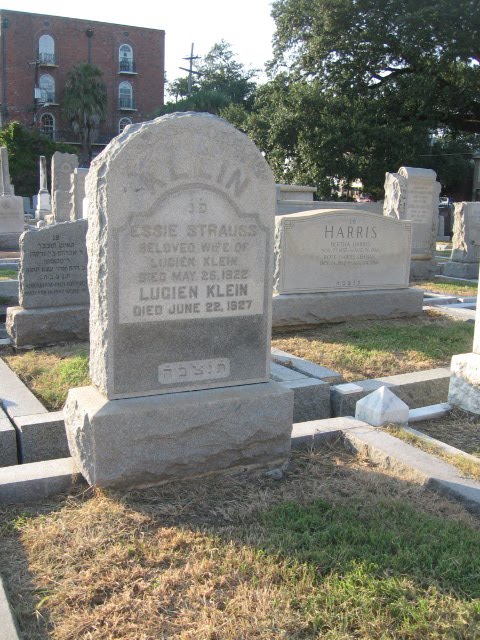

As is expected, all the graves face in the direction of Jerusalem to the east, evidenced by the sunset photo below:

Other corners of the town, long disassociated from any Jewish community (if there ever was one to begin with), still feature apocrypha through none-too-subtle architectural features.


My apologies for the swirled appearance of these photos, but it shouldn’t be so hard to make out a Star of David art window in the attic of these shotgun homes. Nothing about this area, near the intersection of Napoleon and Claiborne Avenues, remotely suggests that it would sit in a Jewish neighborhood today—New Orleanians would most likely perceive it is an extension of the impoverished Central City area, even though it sits well over 2 miles from the old Beth Israel Synagogue featured earlier, and on the other side of Claiborne sits the much wealthier Broadmoor neighborhood. But many old Jewish neighborhoods hide their pulses.

The homes from the rain-soaked photos above sit in the area I indicated with the green oval on the map, while the Chevra Thilim Synagogue sat at the point indicated by the red “A” marker. According to the Greater New Orleans Community Data Center, this site was the second location for the Chevra Thilim congregation, which operated there from 1948 until 1998, when declining membership forced it to merge with another and form a new congregation, Shir Chadash, now located in suburban Metairie. Today, this strip of Claiborne Avenue forms a powerful socioeconomic divider, with a generally affluent population to the north and working class to the south. The Jewish embellishments on these humble shotgun homes suggest that Chevra Thilim may have accommodated an economically diverse population at the time.
Most significant within the context of this lengthy examination, though, is the fact that the current manifestation of Chevra Thilim is now in its third location since 1948; its first was at the intersection of Baronne and Lafayette Streets, right near the city’s Central Business District. Thus, over the course of the lifetime any 65-year-old, the synagogue has moved steadily away from the heart of town, first from downtown to its inner city location on Claiborne Avenue, then out to the ‘burbs. Nothing new here: Chevra Thilim’s move simply parallels the decentralization and suburbanization of just about any constituency that had the financial ability to migrate away from the city center. But is there anything different about Jewish migration patterns from that of the white, gentile (often Anglo-Saxon and Protestant) majority? I have drawn my own conclusions, many of which are clear generalizations based largely on observations, but empirical evidence is the lynchpin of most of my blog articles, and I always welcome others to refute my assertions, either with credible research or more astute observations. Here’s what I have noticed:
1) Jews are settlers but not colonizers; they are not usually the first one in the door. When Alsatian, German, and Eastern European Jews first started arriving to the American South in discernible numbers in the early 19th century, they confronted an area dominated by plantation homes and small villages—a tremendous contrast from the rapidly urbanizing North. But despite the extreme discrimination these immigrants often encountered in Europe, they nonetheless sought to assimilate into mature networks with American gentiles, and they found this in the scattered small-town markets throughout the South. Rather than forging their own new, all-Jewish towns certifiably free of prejudiced goyim, they gravitated toward thriving communities such as Port Gibson, Selma, Donaldson, and Natchez, where their business acumen helped the towns grow. I also find very little evidence of Jews who moved to the south to establish a slavery-dependent plantation in the middle of vacant, uncultivated land; Jews were generally merchants, not farmers, and thus their role in the economy often derived from distribution rather than production, from services rather than manufacturing. In addition, Jews may have been more attuned to the injustices of slavery than gentiles, having experienced personal restrictions of freedom in their respective countries across the Atlantic. Though the attitudes of southern Jews towards African Americans’ rights were mixed, few Jews demonstrated open support for slavery by actually owning slaves. Through most of the South, slaves were a rural enterprise, and Jewish settlement patterns have proven unequivocally urban across the past two centuries.
2) As mobile as most Americans are, Jews take it to an extreme. It doesn’t seem like a very flattering term, but it may only be apt to call Jews “hyper-mobile”. The Jewish outmigration from towns to the big cities is now more or less complete: virtually no Jews live in rural south. Even Mississippi, with an infinitesimal Jewish population of 1,500 today, hosts the vast majority of the remaining Jews in Jackson, the state’s capital and largest city. Understanding Jewish mobility depends upon understanding the ability or capacity to move; it takes money. Jewish merchants were routinely among the wealthiest persons in their southern towns, so as the economic fortunes of these communities deteriorated and people left for the big cities, Jews often seemed to lead the way. The depopulated old Jewish settlements throughout the neighborhoods of larger cities, whether in New Orleans’ Central City or West Philadelphia, reveal the capacity for Jews to relocate as the economic climate of their part of town took a turn for the worse. Jews consistently have among the highest rates of educational attainment of any religious or ethnic group, and in meritocratic America this usually equates to wealth. Wealth endows a person with the ability to move.
3) Jewish relations with American pluralism proved both a catalyst toward their prosperity and a threat to their survival. Jews often sailed across the Atlantic to escape persecution in Europe. American gentiles could be anti-Semetic and likely barred Jews from visiting some of their most exclusive/exclusionary institutions, but the populace was generally relaxed about Jewish-Gentile parings, no doubt in part because southern business leaders have long recognized Jews as savvy entrepreneurs. Though scandalous if not forbidden in much of Europe up until World War II, the idea of intermarriage between Jews and gentiles rarely aroused suspicion in the US. The ability to marry outside of one’s religion supports the notion that Jews were accepted into mainstream Southern society, and it often proved the only opportunity for male immigrants alone in the US to find a bride—a Christian one. If intermarriage galvanized the networking capacity of Jews in America, it also diluted their religious identity. Jews resided in cities such as New Orleans and Selma decades before they could establish a temple, mainly because intermarriage only weakened religious self-identification, so fundamental aspects of Jewish culture remained neglected. Regions with a large percentage of Catholics (such as south Louisiana) seemed the most amenable to crossing religious lines through tying the matrimonial knots. Jews flourished in cities such as New Orleans, but population through natural growth was slow, since many husbands assumed their wife’s Christian faith or became non-observant altogether. Intermarriage rates can serve as a proxy variable for public acceptance of Jews in general, and it is highly possible that the Southern towns with visible Jewish history were among the least prejudiced as well (at least not prejudiced against whites). To this day, Jews routinely intermarry and often eventually repudiate their faith, but a country such as America, founded upon religious freedom, generally fosters a more peaceful co-existence between the general public and religious minorities. Unlike Europe, anti-Semitism has rarely driven policy in the US, so Jewish immigrants most likely always found southern communities perfectly acceptable compared to what they had experienced before—and they remain to this day in the cities with high economic opportunities.
This bird’s-eye scan of Jewish settlement across the South hardly accounts for nuances or even exceptions. But it reveals that a small but influential religious minority, persecuted in Europe, may prove the best example of American restlessness. All across the country, plaques and historical markers remind us of what building used to stand in X location, and all too often that ghost building is a church. Just as we change religion or religious denomination routinely, the physical incarnation of our faith sometimes seems like a pawn in our often fickle spirituality. Churches, cemeteries, storefronts, and even housing have emerged and then disappeared, as the population that animates them grows fidgety. I conclude with three handsome black & white photos (the first time for this blog) of yet another example of vestigial Judiasm, this time in Concordia Hall, an old building in central Little Rock. The photos are courtesy of Nicolette English.

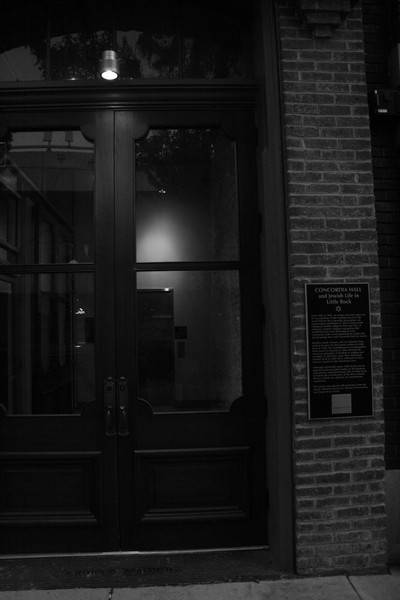

Ever mobile, we abandon the old and obsolete, and, for those aspects of our heritage we care about the most, we erect a sign. This may seem like a cynical statement, but that’s mostly because, as I mentioned earlier, I prefer that my search for Jewish heritage to resemble an archaeological dig, free of written clues or overt references. A good writer knows that showing is always better than telling.




 Posts
Posts


