Showing posts with label Texas. Show all posts

Thursday, April 11, 2013

When a "road diet" removes not just the fat but the bone.

Long perceived as one of the most automobile-dependent major cities in the country, Houston has made considerable strides in recent years toward diversifying its transportation options. The METRORail line, first proposed (and rejected) in 1983, took decades to develop, largely due to persistent political opposition.  However, with a 2001 groundbreaking, the 7.5-mile line, spanning from the University of Houston’s downtown campus toward Fannin South, opened on the first of the year in 2004, relieving Houston of its dubious distinction of being the largest city in America lacking a rail system.

The double-tracked, standard-gauge line operates using infrastructure that adheres to most contemporary light-rail standards; the entire route runs on city streets.  For downtown visitors, the most widely visible segment of the route stretches the full downtown length of Main Street, one of the primary north-south corridors bisecting the innermost of Houston’s three-tiered interstate loops.  By most observations, the physical system appears as slickly contemporary one would expect given its age—at least in consideration of this country’s extremely modest standards for mass transit.

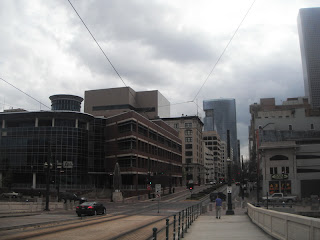
To elaborate further on the trains themselves would be disingenuous of me.  During my latest, brief visit to the city, I confess that I didn’t even ride the line.  But I did walk much of its length through downtown, and I was particularly intrigued by the method by which engineers utilized part of the old vehicular right-of-way along Main Street for the at-grade placement of the track.  The photo below, from just south of the intersection with Dallas Street and looking northward, offers a good example:
I was standing on the side of the street that hosts southbound traffic, and the narrow lane next to me features minimal separation between pedestrian, vehicle, and train.  Small bollards separate the rail from the traffic, and a minor grade change distinguishes the sidewalk.  There’s nothing wrong with this per say, since it allows the ROWs for vehicles and rail to cross one another at conventional intersections with no inherent impingement upon their respective levels of service.  But check the other side of the street, where a few pedestrians are standing in the distance: it hosts the train platforms where the vehicular lane would otherwise be, then transitions directly into a generous sidewalk.  This condition means is that, although the METRORail clearly is bidirectional, Main Street is only one-way southbound.

But is it?  Here’s a view in the opposite direction, looking southward toward Main Street’s intersection with Polk Street, the next block down.
The pedestrians enjoy a spacious walking environment on the opposite side of the street, complete with generous landscaping.  But on the far right of the photograph, south of the intersection with Polk, notice a vehicle (partially obscured by a traffic light) stopped at the intersection, resting on the ROW of Main Street—northbound.  Though my photo does not indicate it, the northbound cars can travel on the block of Main Street from between Polk and Dallas, but north of Dallas, it becomes one-way southbound.

After crossing to the opposite side of Main Street and continuing northward, I discovered that the dedicated ROW for vehicles reveals further eccentricities in the layout.
Midway between Lamar Street and McKinney Street, the ROW for the light rail dominates the overall streetscape, and the tracks themselves merge with a reflecting pool, which in warmer weather (when the pool is full) looks like this.  Here’s a more direct view of the Main Street streetscape looking southward, at a point just south of its intersection with McKinney.
As the photograph proves, Main Street here is a complete pedestrian zone on both sides of the street.  But, on the north side of McKinney, vehicular access resumes.
The grade change between sidewalk and street, coupled with the bollards separating the cartway from the rail, indicates another narrow lane for vehicular access.  But this time, Main Street is only open to northbound traffic, while the METRORail platforms occupy the former southbound ROW.  A block further, north of Main Street’s intersection with Walker Street, the division of roadway uses changes yet again—back to a street with rights-of-way in both directions.  North of Texas Avenue, in the Main Street/Market Square Historic District (and once again on the southbound side of the street), the streetscape looks like this:

While Main Street continues to offer bi-directional vehicular travel all the way to its northern terminus at the downtown campus of the University of Houston (and beyond), it still pulls a few sneaky tricks on the unsuspecting driver.  Looking laterally at the Main Street bridge over the Buffalo Bayou, the configuration is fairly straightforward:
I’m standing in the pedestrian right of way, then comes the southbound rail, then northbound rail, then southbound vehicle, then northbound vehicle, then the opposing sidewalk.  But a southward view of this same street segment (on the bridge) reveals that the pattern shifts.
Notice the dark vehicle stopped in the foreground (near the left of the photo).  It is headed southward, and both sets of tracks are to its right.  But, on the other side of the intersection, the same southbound lane continues on the other side of each of the tracks (where an SUV is turning, partially blocked by a man in a blue shirt).  So, as Main Street passes through the heart of downtown, its order is as such: northbound vehicle, northbound train, southbound vehicle, southbound train.  And if the vehicle on the north side of this intersection (with Commerce Street) were to continue straight ahead, it would directly confront traffic.  It has to veer sharply right, then veer left again almost immediately in order to continue on southbound Main Street.

If that sounds confusing based on my description, you can imagine what it would be like to a driver unfamiliar with the city.  In fact, records show that, despite a year-long education campaign prior to the METRORail’s opening, the line’s crash record measured at over 20 times the national average per track mile, helping the system to earn the nickname of “Wham Bam Tram” among mass transits most ardent opponents.  It would be unfair for me to delve any further into the politics that had long delayed the development of this train, and I have to measure my words even on the critique of the infrastructure, since my knowledge does not extend much beyond the research I have included in this essay.  But the majority of people navigating through Houston’s downtown, by foot, wheel, or rail, will form judgments empirically.  Bearing in mind how few people possess enough transportation engineering wherewithal, the executive decision on how to thread this bidirectional rail line across Main Street seems baffling.  If my photos didn’t get the job done, perhaps this Google Map can better demonstrate the confusion.
The street of focus runs from a southwestern to northeasterly direction, in keeping with the general orientation of downtown Houston’s grid.  If it’s still unclear, my altered version of the map reveals northbound (or northeastern-bound) traffic flow in a purple line, with southbound (or southwestern-bound) traffic in red.
Thus, between Dallas Street and Walker Street, three blocks of Main Street offer a mix of vehicular traffic patterns: one-way north, one-way south, or none (pedestrian and train only), all on a street which through the remainder of its downtown trajectory is two-way.

This ROW strategy effectively diffuses the primacy of this north-south artery in the city’s downtown.  How long would it take even for locals to grow accustomed to these quirks?  While most of the research on METRORail collisions over the years reveals that they have been due to error of private vehicle drivers (not the train operators), it is impossible to know whether the profound problem the system has had is due to a motorist culture unacquainted with maneuvering around trains (as many have understandably asserted) or if the system itself is inherently confusing.  While Houston is hardly the first city in America to remove vehicular rights-of-way in order to provide at-grade light rail, its choice of which lanes to remove seems particularly capricious.  The problem only appears more salient when one views Main Street in the full context of its downtown surroundings:
It’s not particularly easy to tell, but within the general downtown area (framed on three sides by limited access highways and by Buffalo Bayou to the north), the city has virtually no other two-way streets.  Parallel to Main, only Bagby Street on the far west and, to the east, Avenida de las Americas and a segment of Jackson Street share this distinction.  Perpendicular to Main, only part of Commerce Street along Buffalo Bayou is two-way.  None of these streets completely transects downtown.  No streets in the central portion of Houston’s approximately 200-block downtown—aside from Main Street—in are two-way.  Thus, the city’s engineers have ostensibly gelded the only two-way axis, all during a mere three-block segment.

Perhaps the road’s width varied from block to block, and this method proved the only way to introduce light rail and the requisite downtown embarkation platforms without sacrificing critical pedestrian space.  Perhaps the goal (particularly on the vehicle-free Lamar-to-McKinney block) was to foster the pedestrian mall culture prominent throughout European cities, and that the presence of light rail would adequately substitute for the absence of cars.  Perhaps it was purely due to the lobbying of the property owners of the skyscrapers that front these segments of Main Street.  I’m hardly one to denigrate any city for finding ways to calm traffic in what should be the pedestrian-rich downtown.  And frankly, if a city is intending to integrate an urban rail transit system at street level, superfluous car lanes are usually the first that should go. Regardless of the intents, after nearly ten years in operation, the foot traffic along Main Street on a typical weekday afternoon in the early spring scarcely portends an up-and-coming commercial, retail, or entertainment corridor.  It has moments of discernible energy, but large expanses of vacant real estate linger.

Regardless of the propensity for collisions, few outside of the diehard partisans are condemning METRORail’s ability to meet long-term transit goals.  Overall usage has generally met or exceeded expectations: the line achieved its 75 millionth boarding in December of 2010, four years ahead of scheduleAnd, after the completion of a 5.3-mile extension of the existing line, coupled with the introduction of two new lines, the Metropolitan Transit Authority of Harris County will have an identifiable, multi-axis system.  At that point in time (estimated 2015), the system will start adopting colors for the routes (red, purple, green) and distinct names to the new stations, as recommended by the public Superficial as they seem, these naming strategies are helpful in asserting the rail network’s identity as a uniform brand, which in turn can only escalate its aggregate visibility.  And visibility may remain the single strongest argument favoring a fixed-rail system over something more malleable like buses: the permanent presence of rails and catenaries offers a bold signal announcing TRANSIT for even the most unacquainted. (This explains why visitors to a large city will always gravitate toward both above and underground train systems before they will seek out a bus route.)  Clean, lucid visuals may in turn help to bolster passenger use even further on the METRORail (future Red Line), helping to downplay the symbolic clutter fostered by those shifting rights-of-way.

Sunday, June 27, 2010

Civil unrest along the highway.

It is easy to attribute The Great Recession to the increasingly visible decision among many states to cut long-standing social services. In a good portion of the country, publicly supported interstate rest areas have lost much of their reason for being; with so many other options at the exit ramps along our many limited-access highways, it has been hard for them to compete. The average rest area may have much better maintained restrooms than the typical gas station, but food options rarely extend beyond the content of a few vending machines. Picnic areas are a nice touch, but they often rely on visitors packing their lunches and eating them at the site, as well as comfortable weather. These days, most interstate exits leading to a town of at least 5,000 will have at least a couple full service restaurants immediately after the exit ramp. And it’s impossible to recognize the offerings of gas stations without conceding that gasoline may be the most critical commodity that rest areas—outside of the occasional travel plazas on toll roads—typically lack.

Thus, a number of states, in an effort to slash the budgets of their Departments of Transportation, have begun shuttering rest areas. USA Today reported last year that Virginia has been among the most aggressive, slicing nearly half. New Hampshire and Vermont have cut quite a few. Georgia has targeted its rest areas that are close to large cities (where those same services are available in spades), as have Maryland, Michigan, and New Jersey. The aforementioned states, though, are all situated east of the Great Plains, where the distances between settlements are relatively short. However, when Arizona followed suit later in the year, closing an astounding 13 of its 18 rest areas, the action elicited particularly emotional dissent from residents, no doubt attributable to the fact that, throughout the west, the roadside towns spaced between the major cities are few and far between. A state like Arizona may be reasonably well populated, but a disproportionate number of people there call metro Phoenix or Tucson their home, while vast stretches of the Arizona back country are neither inhabited nor serviced with most infrastructure. It’s far tougher in the Mojave Desert than in Connecticut to find an exit with gas and a McDonald’s and a Subway. Truckers, in particular, depend on a secure place to pull off and rest, since many carry their cargo over several nights. Within just the past few days, Arizona’s Department of Transportation announced it was reopening five of the thirteen rest areas that it had previously closed.

This Arizona reprieve suggests that, in at least some parts of the country, the decommissioning of rest areas may manifest itself in a tug-of-war directly paralleling the periods of economic hardship. Clearly a number of states have carefully evaluated the necessity in recent years of these roadside oases—are they the sine qua non for weary travelers that they were in the past? Two bordering southern states offer the most profound contrast regarding how their governments value these once-cherished public services: Louisiana has been implementing austerity measures to its interstate travelers for quite some time, cutting more than two-thirds of its facilities, some of them as long ago as 2000. Conversely, Texas—consistently demonstrating greater resiliency to the recession than most other states—has been using its share of stimulus money to refine its inventory of rest areas. After closing a few of the older ones, the State has also built new facilities, enhancing the amenities offered in the most frequented existing structures, from children’s play zones, pet walking areas, and wireless internet access. The level of investment manifests itself at the Texas-Louisiana border along Interstate 10, near the City of Orange:

Even the most tight-fisted of states would concede that a service station at a boundary should be among the last to get cut. After all, these facilities are often the first structure a motorist encounters after crossing the state line—they aren’t necessarily mere rest areas; frequently they’re welcome centers, and they routinely refer to themselves as such, or in this case, a Travel Information Center. The air-conditioned facility includes interpretive displays, a professional travel counselor, diaper changing stations, a panoply of promotional material for tourist activities in southeast Texas, and a video theatre. Even more impressive is the facility’s back yard, which directly overlooks a vast swamp filled with bald cypress and water tupelo.


This handsome elevated pathway extends about one-tenth of a mile and features educational displays about the ecology of the swamp. The front of the facility shows a comparable level of investment.


The small plaza features a display of flags that loosely encompass Texas’ history as a territory, sovereign nation, and state: the lone star flag, the US flag, flags of Mexico and Spain, and even the French coat-of-arms flag from the 18th century (the northern part of Texas was part of the Louisiana Purchase). But most significant is the Lone Star sculpture in the background of that photo.


From its position immediately to the north of I-10, visible on the right as one crosses the Texas line, this emblem almost achieves landmark status. It’s not quite big or boldly colored enough to stand out from a great distance, but the flags in the plaza puncture the sky and draw the eyes to the site, where they will immediately shift toward the approximately 30-foot sculpture—an effective piece of minimalist pop art that succinctly embodies the spirit of Texas. During my brief visit, several other visitors had their pictures taken in front of the sculpture, and the decision to bury one of the star’s five points has made it appear sturdier and more approachable as a playground feature for children, manifested in the above photo. The flags and the Lone Star sculpture harmonize to form one of the most eye-catching gateways at a state boundary; they more than compensate for the rest area/welcome center facility, which is situated far enough off the road that it would not easily stand out without a prominent fixture poised directly off the highway. The monumentality of the flag/sculpture combination also completely overpowers this far more conventional gateway sign, a little further down the road:


With all these allurements, it’s no surprise that Texas rest areas rate highly among motorists, judging from the array of comments visible online. And having such a comfortable facility right at the boundary is an excellent way of rolling out the welcome mat. But the Department of Transportation has also come under fire for what some would argue is an irresponsible use of stimulus/taxpayer money for the construction of unnecessarily lavish facilities.


Louisiana has taken an opposite approach: the state’s Department of Transportation and Development (DOTD) has virtually no remaining rest areas. The few that remain overwhelmingly sit at state border crossings, like this one on southbound I-55, at the Louisiana-Mississippi line.
It’s well maintained, and the 24-hour bathrooms (in the detached facility to the left of the arcade) are simple but clean. The grounds are small but feature elegant renditions of the amenities we have come to expect at most rest areas.
It does not have any walkable nature trails with educational displays; the rest area’s property lines are relatively small.

Though by no means a disaster, the primary landmark is less effective.
I hate to assert something as shallow as “bigger is better”, but this replica of the shape of Louisiana only stands about 7 feet tall, and while it announces the entrance to the state, it lacks the sublime monumentality of Texas’ flag and sculpture combination. It’s just not big enough to stand out. The absence of any metaphoric content to compare with a proud lone star means this sculpture/sign is semantically almost identical to the blue “Welcome to Louisiana” metal sign that preceded it 300 feet before the rest area (seen in a photo above). The redundancy of these two markers weakens their individual impact. This concrete replica of the state boundaries also sets several yards off from the entrance to the facilities, so it is not integrated into a plaza. Thus, it neither catches the eye nor attracts visitors to take their pictures in front of it when they park at the rest area.

The primary structure to this Louisiana pit stop, employing a full wrap-around portico currently popular in new housing construction throughout the South, hosts the welcome center.

It was not open at the time of this visit, but I’ve been to one in the past, and they feature at least a few of the same amenities as the Travel Information Center in Texas: free wireless in most locations (including the one pictured), maps, tourist activity guides, and trained specialists. They are also under management by the Department of Culture, Recreation and Tourism (CRT).

This placard on the side of the building indicates construction in 2002, a few years after the state began closing its rest areas. Thus, the Foster administration most likely decided to cut the aging, infrequently used, low-service rest areas and consolidate the rest of the activities by building these new rest area/welcome center combos, nearly all of which lie on interstates as they cross into Louisiana boundaries. Despite the enhanced programming at these welcome centers, the cut from 34 rest areas to around 10 (depending on what you count) has surely saved significant operational costs, particularly freeing some of the DOTD’s budget as part of the staffing/programmatic burden has shifted to CRT. Among the few rest areas in Louisiana not at the boundary is the Atchafalaya Welcome Center, at Mile Mark 122 on I-10. I have visited this as well, and it has the same amenities as the welcome centers at state lines, but both directions of traffic flow are funneled to one facility through an exit ramp that passes beneath the highway; again, another device to cut operational costs.

It may appear from this essay that I am singing the praises of the Texas approach of bold and monumental. The state has decided to expand and enhance its artillery of rest areas to wow all the passers-by. But is the Texas approach really that wise? Rather than simply letting businesses take over, it would appear that the State has decided to try outdoing the private sector. The rest area on I-10 at Orange, TX is less of a visitor information center and more of a small museum, which means the State is trying to entice visitors through unique features that the private sector is unlikely to provide. But visitors will still go elsewhere when looking for food or gas—two services which it is unlikely the State could ever justify providing at taxpayers’ expense. In this country in particular, the public sector is nearly always on shaky ground when it attempts to compete with a service the private sector can provide: many Americans perceive that it would be an unnecessary intrusion on private sector territory. In fact, federal law prohibits the privatization of rest areas, based on a 1956 law that intended to protect small businesses when a limited access highway passing through potentially diverted their customer base. (Toll roads were largely exempt because they pre-dated the Interstate Highway Act, which is why the travel plazas on the Pennsylvania Turnpike etc are chock-full of national chains.) Arizona’s DOT has pushed for a change in this federal law, further distancing states from the responsibility of furnishing and maintaining rest areas. Should the federal law be repealed, Texas taxpayers could be in for a rude awakening, having used so much federal stimulus money on extravagant rest area enhancement projects.

Louisiana’s approach is clearly more modest, and it surely elicited grumbling from truckers or locals who now find they have significantly fewer options on the highways. But the State has smartly packaged its formidable cuts on rest areas through the veneer of enhanced tourism: motorists just entering the state still can enjoy 24-hour restrooms, and, during normal business hours, a welcome center committed to optimizing their visit to the state. Meanwhile, new chain restaurants, gas stations, and hotels spring up (and shut down) every day at various exits, creating an overwhelming monotony to the interstate highway traveling experience. Run-of-the-mill rest areas were just another part of that tired rhythm. Whether they’re bold, lavish, and monumental like Texas or modest, sensible, and dull like Louisiana, they reflect the widely divergent cultural attitudes toward a government service which has become almost an institution in itself—but one that clearly needs a reinvention in the wake of our increasingly cluttered transcontinental landscape.

Wednesday, June 16, 2010

No surer sign of Texas envy.

Unfortunately job commitments continue to prevent me from devoting the time to assemble pictures and a credible analysis for the second half of my blog post on neighborhoods in Baton Rouge, but the end is in sight! In the meantime, I can at least briefly explore a topic which may already be widely known among the readers here, but it certainly seems to be common knowledge among the folks from the state who claim this as their own:


Yes, the Lone Star flag flies high in national prominence and proudly among Texans—no doubt they brandish it a bit more boldly than most states would; it is Texas, after all. But from almost any semiotic angle, it’s just a good flag. As I blogged about many months ago when looking at the Maryland flag (waved equally ostentatiously), the communicative properties of flags claims an area of study all its own, known as vexillology. And your average vexillologist would assert that the best flags possess some or all of the following features: simplicity of imagery; direct correlative meaning through colors and patterns; and a scarcity of text or direct illustrations. The Texas flag can claim all of these, and it has helped make the flag among the most memorable state flags in the nation.

But Texans have elevated theirs to an even higher status than most, if not all, other states. It is not uncommon for car dealerships to wave American flags, or even some other promotional flag. But where else besides Texas could one see a flag of this size? The one below (and in the first photo) sits along Interstate 45 at a car dealership slightly north of Galveston.

Equally striking is the absence of an American flag nearby on the dealership’s property. Such deference to a state—at the implied lack of recognition of the nation—would raise an eyebrow elsewhere in the country, but is a common sight in the Lone Star State. Equally routine is the flying of the flag on a separate pole as the US flag, but at the same height.

This image has fuelled the widespread myth that Texas, as a formerly independent nation, is the only one permitted by federal law to fly at the same height as the US flag. Not true. While federal codes do prescribe standards for the handling and display of state flags, they do encourage a variety of approaches beyond conveying that the state flag is superior. Such a notion would also carry an undeniable whiff of favoritism out of Washington DC, and lawyers may argue that preferential treatment for a single state would implicitly violate the Equal Protection Clause.

So maybe it does come down to vexillology to explain the pre-eminence of the Texas flag. The symbols are bold, spartan, and clearly evocative of Texas’ history as a briefly independent nation. The fact remains that Texan pride is only a small component, and the ease for conveying the messages implied by the flag helps it transcend all the lousy state flags out there. New Yorkers, Floridians, and Californians also claim sizable populations but their respective flags are hardly as wedded to the state identity. Maybe if Texas’ flag were as cluttered and unmemorable as that of New York, the state’s residents wouldn’t have it plastered across any feasible flat surface. But the fact remains that they do have this advantage (as do Maryland, and South Carolina, and New Mexico, and all the other places with unambiguously good flags) and when 25 million people can claim it as the banner for their state’s identity, it’s hard for people in the other 49 to overlook it.

Monday, October 12, 2009

Windblown bronze.

Without the time for a lengthy blog post, I leave one that I honestly mean to have no political implications whatsoever. This statue of former president George H. W. Bush may be among the most widely familiar of my photographs; it comes from his heavily trafficked George Bush Intercontinental Airport in Houston.
Regardless of whom it represents, the fact that his sport coat billows behind him instills the presence of wind. But the material that this statue of Bush is made of has a weight and density that even the strongest breeze would hardly stir. I know that plenty of other inanimate sculptures convey motion effectively despite the fact that they derive from inert materials, but the implied wind here only intensifies the sense of an apotheosis beyond the statue’s basic memorializing intentions. Or maybe former President Bush is bravely staring down a gale so mighty it really could blow his jacket behind him—perhaps he’s looking dead into the eye of last year’s Hurricane Ike. The billowing jacket doubles the hero worship.

Thursday, August 6, 2009

Non-variegated skylines.

When I first visited Houston, it took me several hours to decide what seemed so strange when I was observing the skyline while coasting along I-10. Many people have remarked on the acentric nature of the metropolis, how a cluster of skyscrapers at what seems to be the downtown immediately devolve in importance from the presence of another neighboring cluster of skyscrapers, while a third or even fourth ostensible “downtown” looms in the horizon. This is all true, but even the biggest aggregation of tall buildings—the real, original downtown of Houston—seems funny looking on its own terms.

Many websites—Skyscraper City among the most popular—dissect urban skylines’ density and breadth, generally serving as a platform for a detailed discussion of urban concerns. Houston’s skyline seen here from City Data has a moderate degree of multi-dimensionality and thickness to be expected for a city of its size in which the major edifices stand on a variety of streets. (Compare this with New Orleans’ skyline, which seems quite impressive for its breadth from certain angles such as this one from Travelblog but has very little density, because a preponderance of the skyscrapers rest on Poydras Street.)

My own photos, taken from about the twentieth floor of a hotel, try to capture what still seems to be missing this portion of downtown Houston.

It’s a texture that’s missing.

For those of us who grew up in old northern cities (or at least older cities like Indianapolis), Houston’s skyline stands out for the glut of structures dating from the 1970s to the present: glassy cladding above all else, reflective of architectural fashion at the time that Houston began to swell in population to one of the nation’s major cities. One must always consider that Houston was a modest city even up the second World War; Modernism and Art Deco, as well as their associative building materials, are uncommon or often threatened in Houston and other Sunbelt post-war boomtowns. Compare this to New Orleans, which was the largest city in the South in 1900 and remained prominent through the Depression, when cities such Dallas and Houston started to overtake it.

The somewhat homogeneous texture to Houston’s skyline also correlates to a dearth of buildings between four and ten stories in height. Most Midwest and Northeastern cities peaked in the late 1900s, when hydraulic elevators were a pioneer innovation, neither fast nor particularly safe. Thus, buildings were often limited in height to the number of stairs people were willing or able to climb. Houston had a population under 50,000 in 1900, making it the 85th largest city in the country at that time. The proliferation of electric elevators in the 1880s finally allowed the emergence of the first true skyscraper, a 10-story structure in Chicago. As elevators became safer and more efficient in the next decade, buildings would soon surpass this height in Chicago and other cities.

But not in Houston. Though Houston’s leadership attempted to make it a port and railroad hub, the city’s rapid growth, which finally began in the 1920s, is predicated on petrochemicals. Without the logistical prominence of other rail and river cities, Houston lacks a strong warehousing identity. The result is what you see in the photos: high-rise Class A office space, spread thinly by the presence of low-slung, sprawling retail, hotel, and residential construction. This post is too simplistic to serve as a criticism of Houston—it is only natural that Houston’s skyline would look this way, and its lack of variegation in this regard is not a weakness but a reflection of its growth patterns. I have never visited Phoenix or Dallas but suspect that they would look much the same way. What some may denigrate in Houston for its lack of a middle layer of historic century-old buildings achieves a different kind of character through the amorphousness of Houston’s sundry business districts. Part of the city’s identity is that it has multiple business nodes that are often all visible simultaneously across the city’s flat topography. Whether these alternative downtowns are edge cities or ancillary economic clusters, they add a distinct character to the act of driving around Houston that old monocentric cities of the north simply cannot achieve.